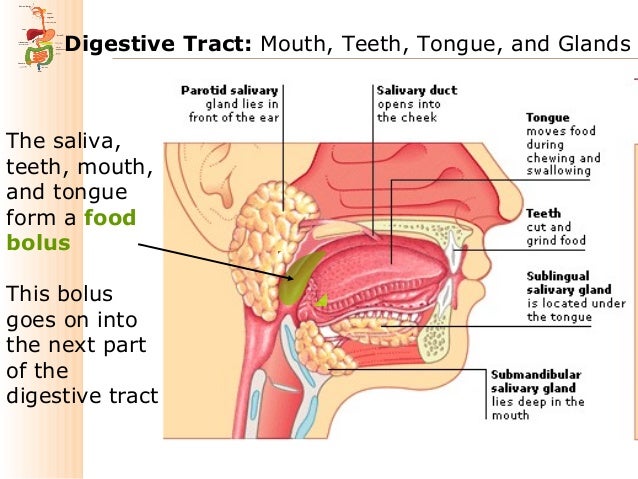
The process of digestion begins with the introduction of food into the mouth and ends with the excretion of waste from the anus. When food enters the mouth, the process of digestion begins; the teeth, tongue, roof of the mouth, lips, and cheeks work together to begin the mechanical breakdown of food where food is broken into pieces by the act of chewing; saliva mixes with the food beginning a chemical reaction, causing the food to form into a ball known as the bolus (Crash Course, 2012). From the mouth, the bolus is then pushed through the parts of the pharynx, located in the back of the throat, down the esophagus by a series of muscle contractions and into the stomach (Sizer & Whitney, 2017).
The next phase of digestion begins in the stomach where additional digestive enzymes and acids are added to the bolus to further liquify and break it down.When the contents of the stomach are sufficiently processed, they are released into the small intestine (Johnstone, Hendry, Farley, & McLafferty, 2014).
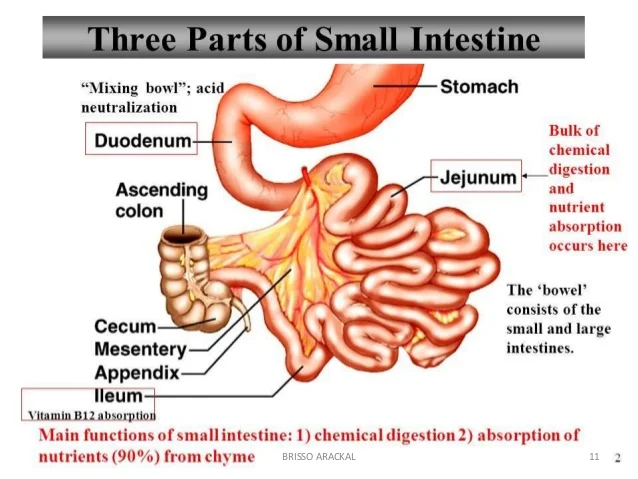
The small intestine is approximately 22 feet long and is made up of three segments: the duodenum, the jejunum, and the ileum (Johnstone, Hendry, Farley, & McLafferty, 2014). The duodenum is primarily responsible for the continued breakdown of the bolus, while the jejunum and ileum are responsible for the absorption of nutrients and delivery to the bloodstream. During this phase of digestion, enzymes are released from the pancreas to help with the digestion of macronutrients. The pancreas also produces insulin to help with the metabolism of sugar (Johnstone, Hendry, Farley, & McLafferty, 2014). The liver primarily processes nutrients that are absorbed by the small intestine, but it also secretes bile to assist with the digestion of fats and helps filter out toxins such as medications or alcohol. Finally, the gall bladder releases bile to further assist with the digestion and absorption of fats (Johnstone, Hendry, Farley, & McLafferty, 2014). At this point, what started out as a partially solid mass, has become more of a liquid which contains bile, enzymes, and water. Once the nutrients have been absorbed, the liquid that is left, then passes through to the large intestine (Hendry, Farley, McLafferty, & Johnstone, 2014).
The large intestine or colon, is approximately 6 feet long and connects the small intestine to the rectum. The colon is made up of five main sections: the ascending colon which includes the cecum and appendix, the transverse colon, the descending colon, the sigmoid colon, and the rectum (Hendry, Farley, McLafferty, & Johnstone, 2014). The main function of the large intestine is to process waste and excrete waste. As the liquid passes into the colon from the small intestine, the water begins to be absorbed by the walls of the colon, ultimately forming into a solid form, called stool. The entire process that the process takes in the forming of stool is approximately 36 hours (Hendry, Farley, McLafferty, & Johnstone, 2014). Once the descending colon becomes full of stool, the contractions of the muscles from within the lower part of the colon begin pushing the stool to the rectum, which is usually when the person is alerted to the fact that there is stool that needs to be eliminated (Hendry, Farley, McLafferty, & Johnstone, 2014). The final part of digestion involves the actual elimination of the stool from the rectum through the anus and into the toilet.

References
Crash Course. (2012). The digestive system: Crashcourse biology #28 [Video file].
Hendry, C., Farley, A., McLafferty, E., & Johnstone, C. (2014). The digestive system: part 2. Nursing Standard, 28(25), 37–44. https://doi-org.proxy
library.ashford.edu/10.7748/ns2014.02.28.25.37.e7459
Johnstone, C., Hendry, C., Farley, A., & McLafferty, E. (2014). The digestive system: part
library.ashford.edu/10.7748/ns2014.02.28.24.37.e7395
Sizer, F. & Whitney, E. (2017). Nutrition: Concepts and controversies (14th ed.). Mason, OH:
Cengage Learning. ISBN-13: 978-1-30563937-9, ISBN-10: 1-305-63937-5

No comments:
Post a Comment